










| Research and Development |
The 1990's proved to be the decade of "downsizing", and corporations with long histories of successful R&D projects are now finding themselves in a position where budgets have been cut and research financing is scarce. It is quickly becoming apparent that research collaborations between industry and academia, industry and government, and industry with industry, are the only viable ways to insure research continuity. This trend has created enormous potential for companies like Thermal-Lube. Thermal-Lube has always made a serious commitment to the research and development of new products and views this as an integral part of its future. In support of the many research projects completed over the past ten years, the company has been certified and accredited as a research facility by both the Federal and Provincial governments.
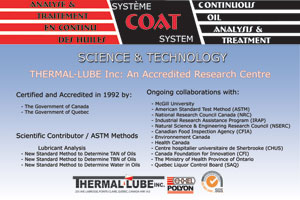 As a result, Thermal-Lube has received funding grants from:
- National Research Council Canada (NRCC)
- Natural Sciences and Engineering Research Council of Canada (NSERC)
- Environment Canada
- Environment Canada Science Horizons
- Canadian and Quebec Government Scientific Research and Experimental Development (SR&ED)
- Canadian Foundation for Innovation (CFI)
Thermal-Lube's continuing practice of investing substantial resources in research and development, while simultaneously expanding into new markets, has been the key to the company's success and will be a major factor in its future growth and profitability.
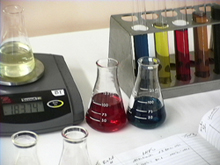 Thermal-Lube is on the cutting edge of research into new lubrication technologies. We have "invented" many products to meet our customer's needs, and many lubrication problems that existed previously have been solved thanks to our creative and persistent approach in working closely with our customers. We have conducted much research and perfected our methods in order to better the development of our special lubricants. The research into synthetic lubricants has yielded products stable to oxidation and degradation. Tested with a vast array of applications under the most severe operating conditions, our lubricants' performances were always consistent and efficient. With the knowledge we possess, Thermal-Lube can tailor its lubricants to be compatible with most chemical processes to prevent unfavorable and undesirable reactions.
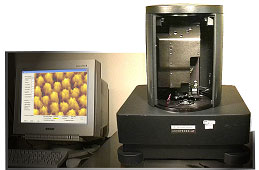 Nanotribology is a new field of opportunity with unlimited potential. Micro-sensors, micro-switches and robotics are just a few of the emerging fields of severe lubrication application technology that require the presence of single molecular films of non-replenishable lubricants
The study of surface interactions on a microscopic level can only be detected through an Atomic Force Microscope (AFM). Thermal-Lube acquired an AFM to determine the efficiency of molecular monolayer film lubricants.
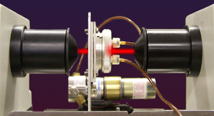 Fourier Transform Infrared (FTIR) spectroscopy analysis of a given "sample" is achieved at the molecular level of its components, and then identified by the spectral image generated. Analysis is carried out by examining each of the chemical constituents in the sample - all at the same instant. FTIR spectroscopy is the fundamental base technology used in developing our patented COAT® System analysers.
Because of the extreme sensitivity of FT-IR spectroscopy and the unique sample handling devices, this unit can also be used to analyse the content of almost anything. Checking levels of lipids, carbohydrates, proteins, water, etc. is important in the analysis of edible products.
Pharmaceutical applications include the discovery, purification and authentication of various targeted substances. Medical uses include blood and tissue analysis.
Using this technology enables us to conduct tests more effectively, and to identify more complex compounds that the traditional "wet chemistry" processes. In addition, the analysis is more direct, therefore less time consuming and less wasteful. Much of our future research is centered on the growing applications of FTIR in a wide variety of industries.
Microbes such as bacteria, yeast and viruses, can be unsafe when present in large quantities. With the proper environment, yeast can grow out into mould and fungi and could cause detrimental effects. Dormant yeast spores are carried though the air until they land on a food source with the appropriate moisture available; then, they can thrive and spread. A typical example is of the hurricane ruins of southern United States , where the hurricanes brought moisture to the building structures, which are mainly of wood. Uncontrolled mould growth could potentially result in great harm to the inhabitants of the homes, causing breathing, problems skin irritations and much more (not to mention the destruction of the structures themselves).
Antimicrobials are chemical compositions that inhibit microbes and the regeneration and spread of microbes before they reach toxic levels. These Antimicrobials are a pre-treatment to the substrate off of which the microbes would thrive, or can be applied as a remediative process. Given that antimicrobials can be applied to a variety of substrates, the possibilities are endless.
Here at Thermal-Lube, we are developing a novel, safe antimicrobial treatment that can be applied easily, and will have a long, effective life. We are working along with the EPA, FDA and various other organizations to ensure that the product meets the highest of standards.
Spectral imaging employs an array detector to acquire a two-dimensional image of a constituent. This method is critical for the accurate detection and definition of certain proteins, viruses, and other molecules that form a relationship or are dependant on one or another. In the past, spectral imaging was used solely by governments (who can afford the high price tag) in satellite picture imaging and tracking. Now, spectral imaging is available for the rapid detection of contaminants and biohazards in the air, in the water, and in the food chain. Thermal-Lube is using the knowledge it has gained through FT-IR research done in collaboration with McGill University to explore this new domain.